
More Than Just a Sport: How Grappling Develops Motor Skills in Children
Why should your child try BJJ? Discover how grappling acts as a cheat code for developing motor skills, body coordination, and safe falling in children.
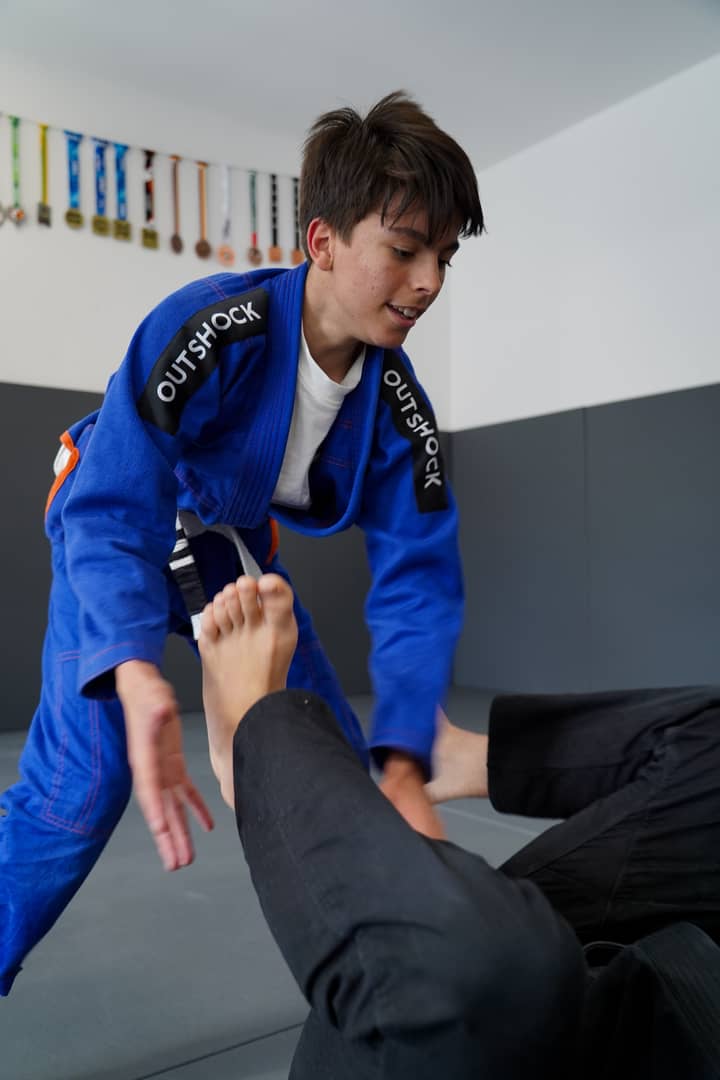
In this article, I want to step away from our adult classes for a moment and focus on a topic that parents ask me about all the time: Why should my kid do martial arts, and specifically, why Brazilian Jiu-Jitsu or Grappling?
Usually, when parents think of martial arts for children, they picture discipline, self-defense, or maybe just a way to burn off endless amounts of energy. All of that is true and valid. But today, I want to skip the obvious points. Instead, I want to talk about something fundamental that often flies under the radar: how grappling serves as an ultimate cheat code for a child’s motor skill development. Here is why rolling around on the mats is about so much more than just learning how to grapple.
1. Proprioception: Knowing Where Your Limbs Are
Let’s be honest: kids can be incredibly clumsy. They trip over their own feet, bump into doorframes, and are constantly growing into bodies they haven't quite figured out yet. This is where proprioception—the awareness of your body in space—comes into play.
In striking sports or regular team sports like soccer, you are mostly dealing with gravity and a ball. In grappling, you are dealing with another human being whose weight and balance are constantly shifting. To sweep an opponent or escape a bad position, a child has to instinctively know exactly where their left arm is, what their right foot is hooking onto, and how their hips are angled—all without looking. This constant, three-dimensional problem-solving on the ground drastically accelerates a child's spatial awareness and body control.
2. Complex Coordination Over Isolation
Many conventional sports heavily favor one side of the body or isolate specific movements. You kick a ball with your dominant foot, or you swing a racket with your dominant hand. Grappling, on the other hand, demands true full-body coordination.
When a kid learns a technique in BJJ, they might need to pull with their left hand, push with their right, bridge with their hips, and step over with their leg—simultaneously. It is essentially rubbing your belly and patting your head, but while wrestling. This cross-lateral movement builds strong neural pathways in the brain. They aren't just building muscles; they are building the neurological wiring that makes them better, more coordinated athletes in whatever other sports they might try in the future.
3. The Art of Falling (And Safe Roughhousing)
I mentioned in a previous article that fighting and roughhousing are human primal instincts. Kids—especially, but not exclusively, boys—will naturally wrestle on the playground or in the living room. It’s how they test their boundaries. Grappling gives them a safe, padded, and supervised environment to do exactly that, without the risk of breaking the coffee table or each other.
More importantly, the very first thing we teach in any grappling sport is "Fallschule" (the art of falling). Before you learn how to throw or take someone down, you learn how to hit the ground safely without posting a stiff arm or hitting your head. Knowing how to fall correctly is arguably the most practical physical skill a child can learn. Whether they are pushed on the playground, take a spill on their bike, or trip while running, the muscle memory of tucking the chin and rolling safely stays with them for a lifetime.
Building Robust Kids At the end of the day, BJJ doesn't just teach kids how to defend themselves; it teaches them how to operate their own bodies efficiently, safely, and confidently. It makes them robust.
If you are curious to see how this looks in practice and want to give your child the opportunity to develop these skills, you are more than welcome to visit us for a trial class at Apis Martial Arts.
Your Next Steps
Step 2 — Bring Your Training Clothes
For your first training, either bring your own Gi or we will provide one for free.
Step 3 — Become a Member
Attend up to 3 free training sessions before making your decision.